How to Keep Your Lunch Hot at Work Without a Microwave: 7 Ways

A cold lunch is fine in July. In January, at a desk or in a truck cab, most people want something hot. If there is no microwave at work, or the line for it eats half your break, you still have good options.
Below are seven ways to keep your lunch hot without a microwave, from a free trick with a jar you probably own to a lunch box that heats food on its own. First, the food-safety rules that decide which method works for you.

Our pick when there is no outlet
Cordless Heated Lunch Box
Heats your meal on its own battery, no microwave or outlet needed. 100W, 1.2L · Free US shipping
The food-safety basics
The U.S. Department of Agriculture (USDA) uses a few simple numbers for packed meals:
- Hot food stays at 140°F or above. Below that, food is in what the USDA calls the "Danger Zone."
- The Danger Zone is 40°F to 140°F. Bacteria grow quickly in this range.
- Two hours is the limit. The USDA says to throw out leftovers that spend more than two hours in the Danger Zone, or more than one hour when it is above 90°F.
- Reheated leftovers should reach 165°F, checked with a food thermometer.
In practice, that means a lunch has to stay either hot or cold all morning. Food that sits lukewarm on your desk until noon is the one thing to avoid.
7 ways to keep your lunch hot at work
1. Preheat an insulated food jar
This is the USDA's own advice for soup, chili and stew. Fill an insulated jar with boiling water, let it stand for a few minutes, pour the water out, and add your food while it is piping hot. Keep the lid closed until lunch. The hot water warms the inside walls, so the jar does not pull heat out of your food in the first hour.
Cost: free if you already own one. Best for: soups, stews, chili and pasta with sauce.
2. Pack it hotter and fuller than you think
Heat the food on the stove or in your microwave at home until it is steaming, right before you leave. Then fill the jar close to the top. A full jar holds heat better than a half-empty one, because there is less air inside to cool the food.
Cost: free. Best for: anyone already using method 1.
3. Add a layer of insulation
Put the jar in an insulated lunch bag, or wrap it in a small towel. It is a simple step, but it slows heat loss on a cold commute or in a chilly truck.
Cost: free to a few dollars. Best for: long commutes and outdoor job sites.
4. Use a plug-in electric lunch box
If your desk has an outlet, a plug-in electric lunch box heats your meal at work. You pack the food cold in the morning, keep it chilled, and plug it in before lunch. It works well for rice, leftovers and casseroles that do not fit in a jar.
Best for: office workers with an outlet nearby.
5. Use a 12V food warmer in the car or truck
Drivers can heat lunch from the vehicle's 12V socket. A 12V lunch box or portable food warmer is a common choice for truck drivers and road crews, as long as the vehicle can power it while you work.
Best for: truck drivers, delivery drivers and anyone who eats in the car.
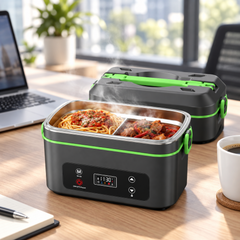
6. Use a cordless heated lunch box
A cordless model works where there is no outlet and no vehicle: a job site, a break room with no free plug, a park bench. It heats your meal with its own battery.
Our Cordless Heated Lunch Box works this way. It has a 100W heater and a built-in 12000mAh battery, enough for about two full heating cycles away from an outlet. In custom mode it heats a meal in as little as 20 minutes, and scheduled heating lets you set the start time in the morning. The 1.2L stainless steel tray is leakproof and dishwasher safe.
Best for: tradespeople, nurses, field workers and anyone who works far from an outlet.
7. Pack a lunch that is good cold
Some days the simplest answer is not to fight the cold at all. Grain bowls, pasta salads, wraps and cold noodles taste good straight from the fridge. Keep them below 40°F with two cold sources, such as gel packs or a frozen water bottle, as the USDA suggests.
Cost: free. Best for: mild days and anyone who just wants to skip the heating step.
Which option is right for you?
- You eat soup or stew most days: a preheated insulated jar.
- You sit at a desk with an outlet: a plug-in electric lunch box.
- You drive for work: a 12V food warmer.
- You work where there is no power: a cordless heated lunch box.
- You want to spend nothing: methods 1 to 3, or a lunch that is good cold.
How to use a heated lunch box safely
Consumer Reports tested six electric lunch boxes and found that none of them kept food at 40°F or below after 20 minutes at room temperature. That matters, because a heated lunch box is a heater, not a fridge. These habits keep it safe:
- Keep the food cold until you heat it. Put the tray in the office fridge if there is one. If not, pack it straight from your fridge and heat it within two hours, or carry it in a cooler bag with ice packs.
- Keep the packed tray in your fridge until you leave. Consumer Reports notes that a chilled tray keeps food cold longer.
- Set scheduled heating with the two-hour rule in mind. The timer is handy, but food should not wait at room temperature all morning before the heater starts.
- Check the temperature the first time. Use a food thermometer to confirm your usual meal reaches 165°F, then you know how long it needs.
- Charge it with the adapter it came with. Like any device with a lithium battery, it should only be charged with its own charger.
Best foods for a hot packed lunch
Moist foods hold and reheat best. Soups, stews, chili, curries, pasta with sauce, rice dishes and casseroles all work well in a jar or a heated lunch box. A splash of water or broth on rice and pasta keeps them from drying out. Crispy and fried foods, like fries or breaded chicken, tend to go soft, so save those for home.
Frequently asked questions
How long does a thermos keep food hot?
It depends on the jar, so check the hours its maker lists. Preheating it with boiling water, filling it close to the top and keeping the lid closed all help. If you are not sure your food is still at 140°F at lunchtime, check it with a food thermometer.
Is it safe to leave food in a heated lunch box all morning?
Only if it stays cold until you heat it. Food that sits at room temperature for more than two hours passes the USDA's two-hour limit. Keep the tray in a fridge or with ice packs, then heat it until it is steaming hot.
Can you put frozen food in a heated lunch box?
Some models can heat frozen meals, but not all. Check the instructions for yours. If you are unsure, thaw the meal in the fridge overnight and heat it chilled.
Are heated lunch boxes worth it?
They are worth it if you want a hot lunch most workdays and have no easy access to a microwave. If you mostly eat soup or only want a hot meal now and then, a preheated insulated jar costs less and does the job.
Ready for a hot lunch without the microwave line? Our Cordless Heated Lunch Box heats your meal without an outlet and ships free in the US. For more ideas, browse our Kitchen Gadgets.
Sources: USDA Reminds Families to Pack Food Safety with Back-to-School Lunches, U.S. Department of Agriculture (August 2025); Leftovers and Food Safety, USDA Food Safety and Inspection Service; Best Electric Lunch Boxes, Consumer Reports.